

Alliant Energy Expands: Customer Growth and Investments Drive Gains
Alliant Energy is accelerating growth through rising customer demand and major investments. Discover how this impacts the energy market and investors.
Alliant Energy Stock Is Quietly Winning Big – Thanks to More Customers, Hungry Data Centers, and Smart Billions in Investments!
Hey friends, if you’re keeping an eye on steady, reliable stocks that aren’t as flashy as tech giants but keep delivering solid growth, Alliant Energy (ticker: LNT) might be one worth noticing right now. This utility company is seeing nice earnings growth driven by a growing number of customers, exploding demand from data centers, and clever management of its supply chain. At the same time, it’s pouring money into infrastructure and renewable energy to make service more reliable and set itself up for the long haul.
Of course, no story is all sunshine – the company, currently holding a Zacks Rank #3 (Hold), still has to deal with rising transmission costs and tricky regulatory issues that could squeeze its profits a bit. But overall, Alliant Energy looks like it’s positioning itself smartly for the future. Let’s break it all down in simple, everyday language so you can understand exactly what’s happening and why it matters.
Alliant Energy: Growth Drivers and Challenges
Alliant Energy serves homes and businesses mainly in Iowa and Wisconsin. Right now, the company is enjoying steady progress thanks to several positive factors working together. More people and businesses are moving into its service areas, which naturally means more customers using electricity and gas. On top of that, the huge boom in data centers (those massive facilities powering AI, cloud computing, and all our online stuff) is creating extra demand for power. Alliant has already locked in contracts for a total of 3 gigawatts from these data centers, with long-term deals signed with solid, reputable clients. That’s a big vote of confidence and should help boost the company’s financials going forward.
Good supply chain management and careful cost control are also helping Alliant keep its revenue growing consistently. The company is aiming for annual earnings growth of 5-7%, and it expects earnings per share to grow by more than 7% each year from 2027 through 2029. That’s pretty healthy for a utility stock, which many investors like for its stability rather than wild ups and downs.
What’s really helping Alliant stand out is its smart way of spending money on the future. The company is investing heavily in renewable energy and better infrastructure. This not only makes the power supply more dependable but also supports cleaner energy goals that many customers and regulators appreciate. Between 2026 and 2029, Alliant plans to put a massive $13.4 billion into its business. This investment is expected to grow its rate base by 12%. As part of that, they’re adding 1,000 MW of energy storage and 1,300 MW of new renewable capacity to handle the rising demand in their markets. It’s a clear sign they’re not just reacting to growth – they’re actively preparing for it.
However, like any utility, Alliant faces some real challenges too. Its two main subsidiaries – Interstate Power and Light Company and Wisconsin Power and Light Company – depend on interstate transmission systems that they don’t own or control. The rates for using those systems are set by the Federal Energy Regulatory Commission (FERC). If transmission costs go up or if the third-party operators don’t perform well, it could hurt Alliant’s operations and eat into its profit margins.
On top of that, the company has to follow strict environmental rules at both the federal and state levels. Any slip-up in meeting these regulations could cause operational headaches and hit the bottom line. So while growth looks promising, Alliant will need to navigate these hurdles carefully to keep delivering for its investors and customers.
Key Growth Factors for LNT
Let’s talk more about what’s fueling this positive momentum. Alliant’s service territory is seeing real economic development, which brings in new homes, businesses, and industries. That naturally expands the customer base and increases overall demand for utility services. Having a diverse mix of customers – residential, commercial, and now big data center clients – helps keep earnings more stable even when the economy has its ups and downs.
The data center deals are especially exciting. Securing contracts for 3 gigawatts is no small thing. These long-term agreements with trustworthy partners mean Alliant has visibility into future revenue, which is great for planning and reduces some of the uncertainty utilities often face. In a world where AI and digital services are growing fast, reliable power providers like Alliant are becoming more important than ever.
Add in their strong supply chain and focus on keeping costs in check, and you can see why the company feels confident about hitting that 5-7% annual earnings growth target. The projection of more than 7% EPS growth per year from 2027 to 2029 shows they believe the investments they’re making now will start paying off nicely in the coming years.
The capital spending plan is a big piece of the puzzle. That $13.4 billion between 2026 and 2029 isn’t being thrown around randomly – it’s targeted at making the grid stronger, adding renewable sources like wind and solar (plus storage to make them more reliable), and upgrading distribution systems. By growing the rate base 12%, Alliant can earn a return on these investments, which supports both reliable service and long-term shareholder value. It’s a balanced approach: meeting today’s needs while building for tomorrow’s cleaner, higher-demand energy world.
Challenges Facing LNT
No growth story is without risks, and Alliant has a few worth watching. Because its subsidiaries rely on transmission lines owned by others, any sudden jump in those costs can directly affect how much Alliant spends and how much profit it keeps. If the operators of those lines face issues or delays, it could also impact service quality for Alliant’s customers.
Environmental regulations are another area that requires constant attention. Utilities operate under close watch from government bodies, and rules around emissions, renewable targets, and safety can change or get stricter. Staying compliant takes planning and money, but failing to do so could lead to fines, forced changes, or reputational damage.
These challenges are common in the utility sector, but how Alliant manages them will play a big role in whether it can fully deliver on its growth promises.
LNT’s Recent Stock Performance
On the stock market side, Alliant Energy’s shares have been doing reasonably well lately. Over the past three months, the stock price has climbed about 14.0%. That’s a bit better than the industry average growth of 12.1%, which suggests investors are noticing the positive developments around customer growth and the big investment plans.
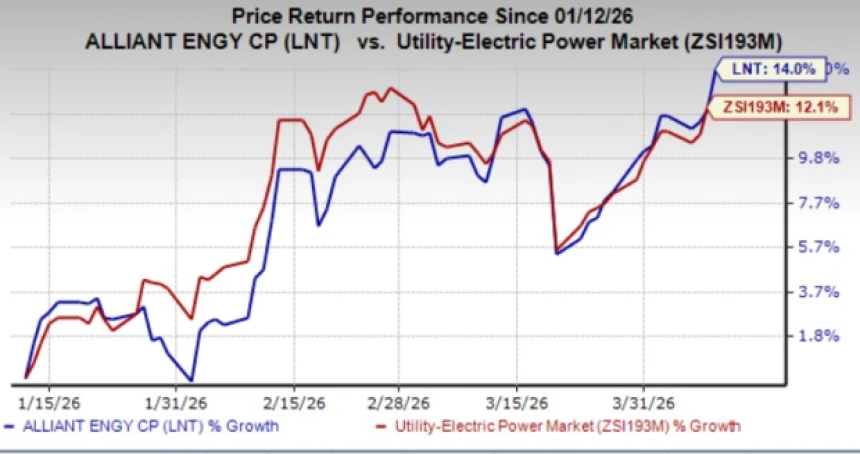
Image Source: Zacks Investment Research
Of course, stock prices can move for many reasons, including overall market sentiment, interest rates, and energy sector trends. But the recent outperformance is a nice sign that the market is giving some credit to Alliant’s strategy.
Other Utility Stocks to Watch
If you like the utility space but want to look at a few more options, here are some higher-ranked stocks according to Zacks:
- CMS Energy (CMS) – Currently Zacks Rank #2 (Buy), with a dividend yield of 2.89%.
- DTE Energy (DTE) – Also Zacks Rank #2 (Buy), offering a dividend yield of 3.13%.
- Duke Energy (DUK) – Zacks Rank #2 (Buy), with a solid dividend yield of 3.24%.
All three have yields well above the Zacks S&P 500 composite average of 1.41%. Looking ahead to 2026, analysts expect earnings per share of $3.86 for CMS Energy (projected growth of 6.93%), $7.72 for DTE Energy (4.89% growth), and $6.71 for Duke Energy (6.34% growth). These are worth considering if you’re building a portfolio focused on steady income and moderate growth.
Free Report: Capitalizing on the Next AI Boom
By the way, the massive wave of artificial intelligence is creating huge opportunities, not just for tech companies but also for the utilities powering all those data centers. Early investors in names like Nvidia saw amazing returns, but the next phase might belong to supporting players in energy and infrastructure. A Zacks report called “AI Boom 2.0: The Second Wave” highlights some lesser-known companies that could ride this trend – something utility investors might find interesting.
Additional Resources
If you want deeper dives, Zacks Investment Research offers free stock analysis reports on several of these companies:
- Duke Energy Corporation (DUK)
- DTE Energy Company (DTE)
- CMS Energy Corporation (CMS)
- Alliant Energy Corporation (LNT)
Alliant Energy’s story right now is a classic example of a traditional utility adapting to modern demands. More customers moving in, data centers signing big contracts, and billions being invested in renewables and reliability – these are real tailwinds. At the same time, the company is staying grounded by acknowledging the challenges around transmission costs and regulations.
For everyday investors who prefer stability, dividends, and long-term growth over high-risk bets, Alliant (and its peers) offer a way to participate in the energy transition and the AI boom without chasing every hot tech stock. Of course, always do your own research or talk to a financial advisor, as markets can shift and past performance doesn’t guarantee future results.
Whether you’re already holding LNT or just curious about utility stocks in 2026, the combination of customer growth, data center demand, and heavy infrastructure spending makes Alliant Energy one to keep on your radar. It’s not the most exciting headline every day, but steady, well-managed growth can be pretty rewarding over time.