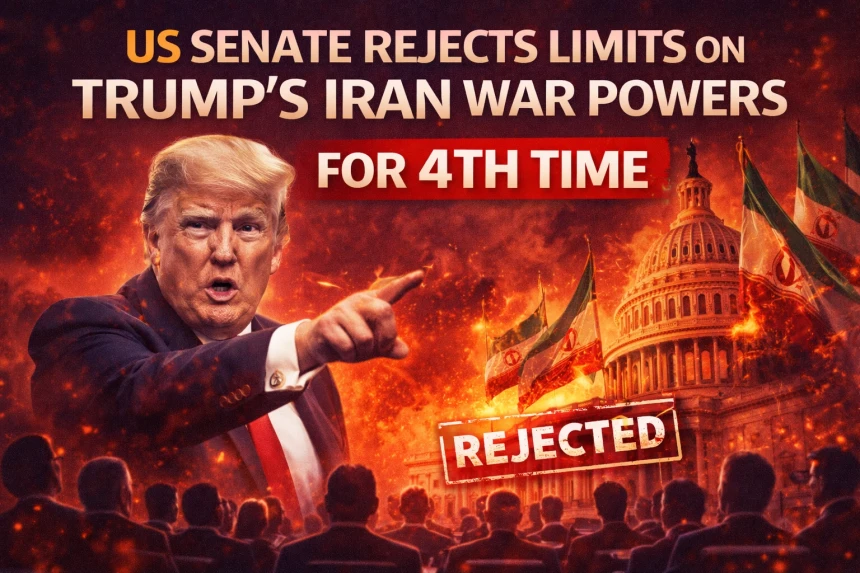

War Powers Battle: Senate Votes Down Iran Limits on Trump Yet Again
The US Senate has once again rejected attempts to limit Trump’s authority in the Iran conflict—marking the fourth failed effort amid rising tensions and political divisions.
Senate Shuts Down Trump's Iran War Power Limits for the FOURTH Time – Cross-Party Drama, Record Dissent, and Fresh Sanctions Bombshell!
In a stunning move that's got everyone talking in Washington, the US Senate has once again shot down a plan to put serious checks on President Donald Trump's war powers when it comes to Iran. This marks the fourth time this year that lawmakers have rejected the idea, which would have forced the President to get Congress's green light before any future military action there. The proposal didn't even make it through – it fell short in a tight 47-52 vote, as reported by CNN.
What makes this vote extra interesting is the way senators crossed party lines. Democratic Senator John Fetterman decided to break ranks and vote against the resolution, joining the Republicans. On the flip side, Republican Senator Rand Paul stood with the Democrats in backing the measure. It's the kind of rare split that shows just how divided things are right now on foreign policy and presidential power.
But Democrats aren't backing down one bit. According to CNN, Senate Minority Leader Chuck Schumer made it clear that his party plans to keep bringing these kinds of votes up regularly. They're determined to keep the pressure on. At the same time, some Republicans are starting to show a bit of flexibility. For instance, Senator Thom Tillis has hinted he might be open to rethinking restrictions if the situation in Iran drags on longer than 60 days. And GOP leadership hasn't completely ruled out holding a future vote to actually authorize military force once we hit the 90-day mark. It's a small opening, but in the high-stakes world of US-Iran tensions, every signal counts.
This latest rejection comes at a time when the Senate is already dealing with a bunch of hot-button military and foreign policy issues. In fact, on the same day, the chamber also voted down two major measures tied to US military support for Israel, according to reports from Al Jazeera. These weren't small decisions – they involved big-ticket arms sales that have sparked a lot of debate on Capitol Hill.
First up was a resolution pushed by Independent Senator Bernie Sanders aimed at blocking a massive USD 295 million sale of bulldozers to the Israeli military. In a rare moment of unity among Democrats, a record number backed the move – 40 out of the 47 Democrats in the Senate voted in favor. That's a strong showing, but it still wasn't enough. The measure failed, with 59 senators voting against it, including every single Republican. It was a clear party-line split at the end of the day, even if the Democrats came closer than usual.
Then there was a second resolution trying to stop the sale of USD 151.8 million worth of 1000-pound (that's about 450 kg) bombs to Israel. This one got even less support, pulling in only 36 votes in favor before it too was voted down. These back-to-back defeats highlight how tricky it is right now to shift US policy on arms sales, especially when it involves key allies like Israel amid ongoing regional conflicts.
All of this Senate action is happening against a backdrop of fresh warnings from the highest levels of the Trump administration about cracking down on Iran's financial lifelines. Earlier on Wednesday (local time), United States Secretary of the Treasury Scott Bessent stepped up to the microphone and delivered a strong message. He said the US is ready to slap secondary sanctions on Chinese financial institutions if they get caught helping with Iranian financial flows. It's a direct threat aimed at anyone still doing business that could prop up Iran.
Bessent didn't mince words during the press briefing. He reminded everyone that "Iran used to be the largest state sponsor of terrorism." He pointed out how China had been buying more than 90 per cent of Iran's oil – which, by the way, makes up about 8 per cent of China's total energy needs. That's a huge chunk of business that's been going on for years. But Bessent believes recent events could change everything. "We believe that due to the blockade in the Straits, there will be a pause in Chinese buying," he explained. He's talking about the tensions heating up around key maritime routes that are critical for oil shipments. With everything that's unfolded since the February 28 US-Israel attacks on Iran, those supply lines are under serious strain, and it looks like Beijing might be hitting pause.
The Treasury Secretary didn't stop there. He also dropped news about US policy on oil from Russia and Iran. "We will not be renewing the general license on Russian oil and Iranian oil," Bessent said clearly during the media briefing. That general license had allowed some limited transactions, but only for oil that was already on the water before March 11th. According to him, all of that has now been used up. No extensions, no renewals – the door is closing tight amid the ongoing geopolitical tensions. It's another sign that the administration is tightening the screws on energy deals that could benefit Iran or Russia.
And just a day earlier, on Tuesday (local time), President Donald Trump himself jumped into the conversation with some big claims about China and Iran. In a post on his Truth Social platform, Trump said China has committed to stopping all weapon supplies to Iran. He credited his personal diplomatic chats with Chinese President Xi Jinping for making it happen. Trump painted a picture of Beijing getting on board with Washington's goals, especially when it comes to keeping the Strait of Hormuz wide open permanently.
The Strait of Hormuz is no ordinary waterway – it's a vital global energy corridor that carries a huge portion of the world's oil supply. Tensions there have been boiling over ever since those February 28 US-Israel attacks on Iran, turning it into a flashpoint for the entire region. Trump's message was clear: thanks to his direct talks with Xi, China is now supporting efforts to make sure that strait stays open for business, no matter what. It's the kind of announcement that could shift alliances and ease some pressure points, but it's also coming at a moment when everyone is watching closely to see if actions match the words.
Putting it all together, these Senate votes and the administration's latest statements show just how complicated the situation around Iran has become. Lawmakers are clashing over how much power the President should have to act alone, while at the same time debating arms deals and potential sanctions that could ripple across the globe. The cross-party votes – like Fetterman going his own way or Rand Paul teaming up with Democrats – remind us that even in a polarized Washington, foreign policy can still create some unexpected alliances.
Democrats like Chuck Schumer are signaling they'll keep forcing these war powers questions onto the floor, hoping to build momentum over time. Republicans, meanwhile, aren't slamming the door completely on future discussions, especially if things escalate beyond the 60- or 90-day windows. It's a waiting game, but one with real stakes for US troops, allies, and global stability.
Then you have the arms sales votes, which spotlight the deep divisions over US support for Israel. Bernie Sanders' push got more Democratic backing than usual on the bulldozer deal, yet it still crashed against a wall of Republican opposition. The bomb sale resolution fared even worse. These aren't just numbers on a scorecard – they represent real debates about military aid, human rights concerns, and America's role in the Middle East.
On the economic front, Secretary Bessent's warnings about Chinese banks and Iranian oil paint a picture of the US getting tougher on sanctions enforcement. By calling out Iran's past as a terrorism sponsor and highlighting China's massive oil purchases, he's laying out the case for why secondary sanctions could be next. The expected pause in Chinese buying due to the straits blockade adds another layer – it suggests the administration sees diplomatic and military pressure already working to disrupt those flows.
And let's not forget the oil license decision. Ending the general license for Russian and Iranian oil shipments that were already at sea before March 11th sends a strong signal. No more wiggle room there. It's all part of a broader strategy to cut off funding sources that could keep tensions alive.
Finally, Trump's Truth Social update about China halting weapons to Iran feels like a potential game-changer. His one-on-one talks with President Xi seem to have yielded a commitment, at least according to the President, and the focus on keeping the Strait of Hormuz open could help calm markets and energy prices worldwide. In a region that's seen so much friction lately, any sign of de-escalation gets noticed fast.
From the Senate floor to the Treasury briefing room and straight to the President's social media, the message this week has been loud and clear: the Iran situation is front and center, and every player – from lawmakers to top officials – is maneuvering carefully. Whether these votes and statements lead to real policy shifts or more gridlock remains to be seen. But one thing's for sure – the drama in Washington over war powers, arms deals, and sanctions is far from over, and it's affecting everything from global oil routes to America's alliances abroad.
Americans watching from home might be wondering what it all means for everyday life. Tighter sanctions could push up gas prices if oil flows get disrupted further. The back-and-forth on presidential powers raises big questions about who decides when the US gets involved in conflicts overseas. And those Israel-related votes show how even routine arms sales can spark heated battles in Congress.
As the days unfold, expect more of these pushes and pulls. The Senate's repeated rejections of the war powers measure haven't stopped Democrats from trying again, and the administration's firm stance on sanctions and oil licenses suggests they're not waiting around for Congress to act. With Trump claiming diplomatic wins with China and key straits in the spotlight, the story of US-Iran relations is evolving quickly.
This fourth rejection might feel like déjà vu for some, but the details – the party-line crosses, the record Democratic support on one resolution, the specific dollar amounts on arms sales, and the precise warnings from Bessent – all add up to a week full of high-stakes decisions. It's politics, diplomacy, and national security all wrapped into one, and it's playing out in real time for the world to see.